How laser hair removal works
Each hair grows from a follicle that moves through three stages: a growth phase (anagen), a short transition (catagen) and a resting phase (telogen), after which the hair sheds and the cycle starts again. Only in the growth phase is the hair still anchored to the living base of the follicle, the part that makes new hair.
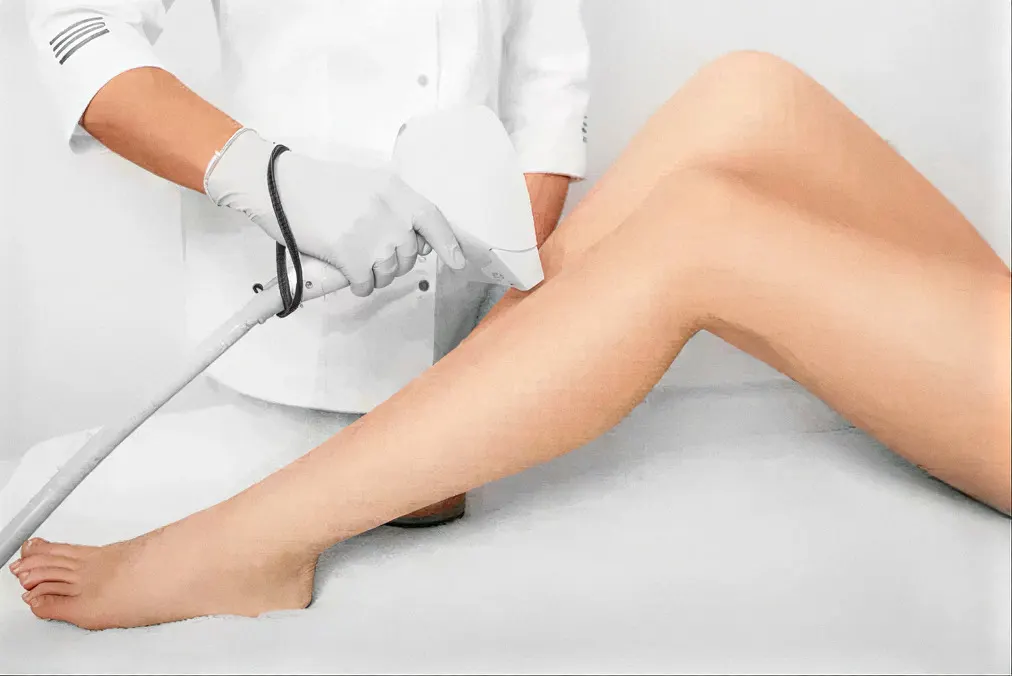
Laser hair removal works on a principle called selective photothermolysis. A laser gives out light of one wavelength, and melanin, the dark pigment in hair, absorbs it strongly. The light becomes heat along the hair shaft and down into the growing follicle, enough to damage the structures that regrow hair while the surrounding skin is cooled and largely spared. A follicle treated this way either stops producing hair or produces a finer, lighter one.
Skin carries melanin too, and deeper Indian skin tones (Fitzpatrick III–V) carry more of it. That is why wavelength and energy decisions matter so much. A longer wavelength such as Nd:YAG 1064 nm is absorbed less by the upper layers of skin and reaches the follicle with less risk to the surface, while a multi-wavelength diode lets the dermatologist balance settings for skin and hair together. Fluence (the energy delivered per pulse), pulse length and cooling are then adjusted to how your skin responded at the patch test.
The same physics explains the limits. Grey, white and very fine blonde hair has almost no melanin, so there is nothing for the light to heat. Hormones can also bring new follicles into play over time, which is why PCOS-related hair needs a longer course and periodic maintenance.
About UNCOVER
UNCOVER Clinics runs dermatologist-led clinics in Gurgaon, Delhi and Noida. Delhi has three of them: Greater Kailash 2 in the south, Punjabi Bagh in the west and Preet Vihar in the east. Laser hair removal follows the same consultation and patch-test process at each, built on three commitments.
- A dermatologist makes the decisions. An MD dermatologist examines your skin and hair, orders the patch test, sets the number of sessions and the gap between them, and chooses the wavelength and energy for each area at every visit. Experienced technicians carry out the treatment under that supervision.
- Lasers chosen for Indian skin. The clinics use Alma Soprano Titanium and InMode Triton, both US-FDA cleared, so the wavelength can be matched to your skin type instead of one setting being used on everyone.
- Pricing you can check. You get a written quote valid for 30 days, a written list of every area in your package before you pay, and a top-up rate fixed on the first day. EMI is available on packages, and unused sessions carry over to any UNCOVER clinic.
What we will not do is promise you a number. A full course typically brings around 90% reduction, but hair colour, density and hormones decide where you land, and the dermatologist will tell you at the consultation if your hair is unlikely to respond.
Why six to eight sessions, and not two?
Think of the hair in any area as several overlapping batches rather than one. On the day of a session, only some follicles are in the active growth phase, and those are the only ones the laser can disable. The rest are resting or shedding, and they move into growth over the following weeks.
That is what the 6–8 week gap on the body is for: long enough for the next batch to enter the growth phase, and not so long that the area slips back. Facial hair cycles faster, so the upper lip, chin and full face are treated about every four weeks across 8–10 sessions. Over 6–7 months, the repeated sessions catch most follicles in the area at least once at the right moment.
Two sittings would reach two batches. You would notice some thinning, then steady regrowth from follicles that were never treated. Coarse male hair usually needs 8–10 sessions and hormonal facial hair 10–12. If a clinic suggests you will be finished in one or two visits, take that as a reason to keep looking.
What "permanent" honestly means
The accurate term is permanent hair reduction rather than permanent removal, and the difference is worth understanding before you sign up for a course.
After a complete course, a typical result is around 90% reduction in the treated area. What grows back tends to be sparse, finer and lighter, so shaving every other day turns into an occasional tidy-up. Not everyone lands in the same place: dark, coarse hair on lighter skin tends to respond most readily, while hormone-driven hair keeps producing some new growth.
Where hormones are involved, as with PCOS, plan on 2–3 maintenance sessions a year after the main course. Others may want an occasional top-up session later on, and the rate for it is written into your plan from the start, so there are no surprises down the line.
What a session is actually like
A session takes anything from about 10 minutes for underarms to 2–2.5 hours for full body, and a good share of that time goes into preparation. The order is the same at every visit:
- Hair and skin check. The team looks at how much has regrown and whether your skin has tanned since the last visit, and the dermatologist confirms the settings for each area.
- Shaving. The area is shaved close so the laser energy is spent inside the follicle, not on hair above the skin.
- Marking. Zones needing different settings are outlined, so every patch gets covered once and only once.
- Gel application. A layer of cooling gel goes on to protect the surface and keep the heat comfortable.
- Laser. With eye shields on, the handpiece is moved steadily across each zone. The sensation usually scores 2–4 out of 10, and numbing cream is free if you would like it.
- Aftercare. Moisturiser and sunscreen go on. For the next 24–48 hours, skip the gym, steam, sauna, swimming, hot showers and sun, and keep using SPF 50 every day.
You can go straight back to work. Before leaving, book your next visit for 6–8 weeks later (about four weeks for the face), ideally on a day you would be near the clinic anyway.
References
- Indian Association of Dermatologists, Venereologists and Leprologists: standard guidelines of care for laser hair reduction
- US FDA, Laser Facts: Removing Hair Safely
- Alma Lasers, Soprano clinical documentation
- InMode Triton, multi-wavelength platform clinical documentation