How laser hair removal works
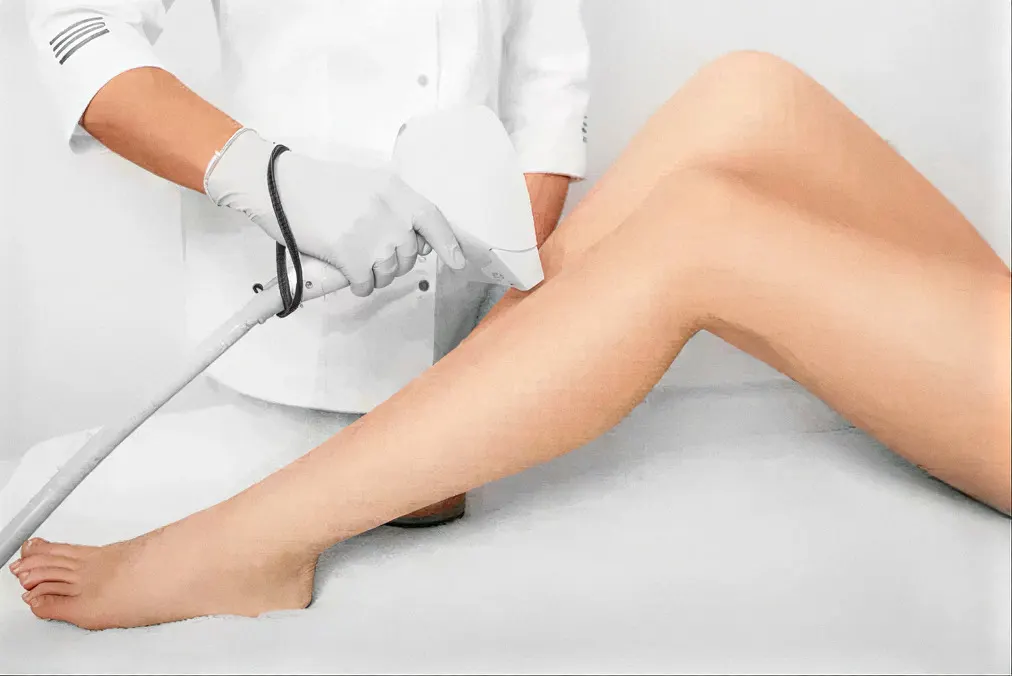
Hair doesn't all grow at once. Each follicle cycles through growth, rest and shedding, and only one in the growing stage, with the hair still anchored to its pigment-rich bulb, makes a good target. The laser is tuned to a wavelength that melanin absorbs; the pigmented shaft soaks up the energy, and the heat it generates damages the follicle's ability to produce another hair.
On lighter skin almost any hair-removal wavelength finds the hair first. Indian skin, usually Fitzpatrick III–V, carries plenty of melanin itself and competes for the same light. The answer is a longer wavelength: Nd:YAG at 1064 nm passes through the upper skin with less absorption and reaches the follicle deeper down, while multi-wavelength diodes let the dermatologist blend settings for the area in front of them. Fluence (the energy delivered), pulse duration and cooling are fine-tuned for the hair's thickness and how the skin responds.
This is also why waxing and threading have to stop once a course begins. Laser needs the hair's root in place to act on. Shaving leaves the root untouched, so it is the one method you can keep using between sessions.
About UNCOVER
UNCOVER runs dermatology clinics in Delhi, Gurgaon and Noida, and laser hair removal is handled the same way at each of them:
- Doctor-led plans. An MD dermatologist writes your course, oversees it, and picks the wavelength and energy area by area. The sessions themselves are done by technicians with over ten years' experience.
- Devices. The two platforms named are InMode Triton and Alma Soprano Titanium, both US-FDA cleared; between them they run Nd:YAG 1064 nm or several diode wavelengths for Indian skin.
- Pricing in writing. Before any money changes hands you have the area list on paper, a quote that holds for 30 days and a top-up rate that won't change later. Packages can be paid by EMI.
- Room to pause. Sessions you haven't used roll forward and are accepted at every UNCOVER clinic.
If you're in Faridabad, your nearest UNCOVER clinic is Greater Kailash 2 in South Delhi, an easy trip up the Violet Line. This page walks through what a course involves, so you can weigh it up and plan it around your week.
Why it takes six to eight sessions, not two
If every hair were growing at the same time, one or two sessions might do the job. They are not. In any patch of skin, only some follicles are actively growing on a given day; the rest are resting and carry little or no hair for the laser to heat. A session disables the growing ones, and the resting ones only become treatable weeks later when they enter their own growth phase.
That is what sets the rhythm of a course: 6–8 sessions for most body areas, 6–8 weeks apart, and closer to 4 weeks for the upper lip, chin and face, where hair cycles faster. Coming back too soon catches few new follicles; leaving it much longer lets them slip past. For anyone travelling in, the long gaps are useful, because a body-area course needs only a visit every month and a half or two rather than a weekly commitment. Typically you see 10–25% fewer hairs after session one and a visible change by session four, with the full reduction building across the course.
What "permanent" honestly means
In dermatology, "permanent hair reduction" means a lasting drop in the number of hairs that regrow, not a promise that none ever will. After a full course most people see around 90% reduction, and how much depends on the colour and density of the hair and on hormones. The hairs that remain are usually finer and lighter, and shaving tends to become an occasional job rather than a routine one.
Hormones are the main reason hair returns. With PCOS, thyroid conditions or other hormonal changes, the body can activate new follicles over time, so a maintenance session or two a year is a normal part of the plan rather than a sign the course failed. A good consultation tells you this at the start, before you pay.
What a session is actually like
After the consultation and patch test, every visit runs in the same order:
- Check-in with the dermatologist. Hair growth and skin are reviewed, and settings are adjusted in light of how you responded last time.
- Shaving. Any stubble is taken down to skin level so no energy is wasted on surface hair.
- Marking. Lines are drawn where one setting should give way to another.
- Gel. A cool layer goes on to keep the skin comfortable.
- Laser. The chilled handpiece works through each zone. Most people describe it as 2 to 4 out of 10; if you want numbing cream, it's free.
- Aftercare. Moisturiser and sunscreen are applied. Over the following 24–48 hours avoid sun, the gym, steam and pools, and skip hot showers; SPF 50 becomes a daily habit.
You can return to work the same day. If you have a long ride home, carry a light layer to cover treated skin from the sun.
References
- Indian Association of Dermatologists, Venereologists and Leprologists: standard guidelines of care for laser hair reduction
- US FDA, Laser Facts: Removing Hair Safely
- Alma Lasers, Soprano clinical documentation
- InMode Triton, multi-wavelength platform clinical documentation