How laser hair removal works
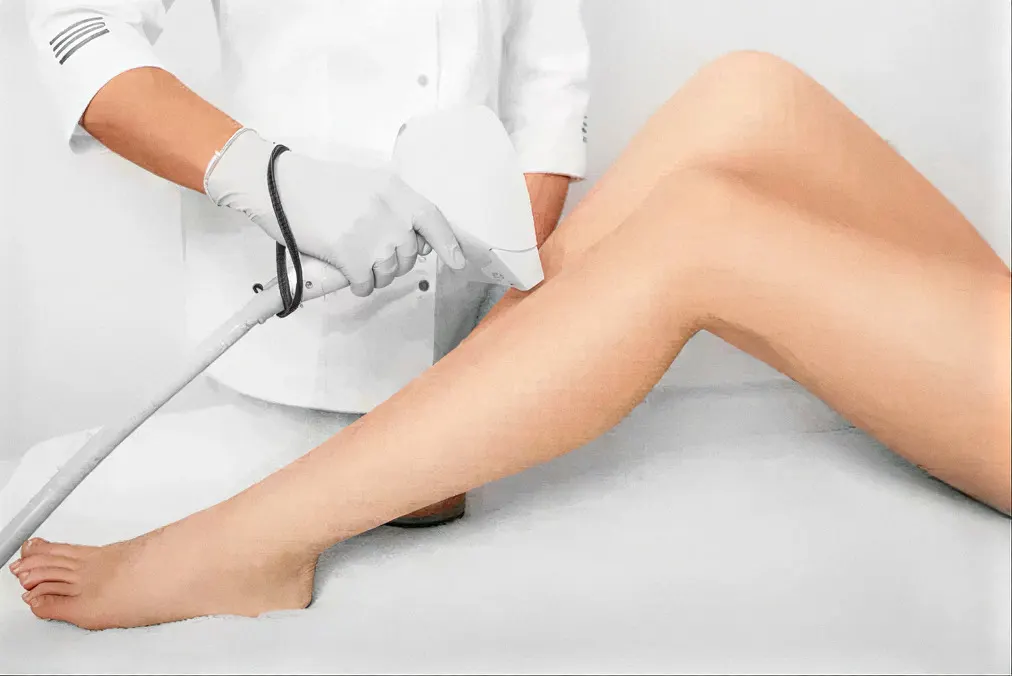
Every hair grows from a follicle, a small pocket in the skin fed by its own blood supply. The hair shaft and the base of the follicle hold melanin, the same pigment that gives hair its colour. A hair removal laser emits light at a wavelength that melanin absorbs well. The light turns into heat inside the follicle, and enough heat, delivered for the right length of time, damages the parts of the follicle that make new hair.
Timing matters because hair grows in cycles. Only follicles in the active growth phase are firmly attached to a pigmented hair, so only those take the full effect. Follicles that are resting, or shedding, are left largely untouched on the day and have to be caught at a later session once they start growing again.
On Indian skin there is a second layer to think about. Fitzpatrick types III to V carry more melanin in the upper skin, which competes with the hair for the light. Longer wavelengths such as Nd:YAG 1064 nm travel deeper and are absorbed less by skin pigment, and multi-wavelength diode platforms combine wavelengths to balance safety and results. The dermatologist also adjusts fluence, pulse and cooling for each area, which is why the same machine can be gentle on an upper lip and still effective on a thick back.
About UNCOVER
UNCOVER Clinics is a group of dermatologist-led clinics in Delhi, Noida and Gurgaon. Three principles shape how laser hair removal is done.
- A doctor in charge. Each plan is drawn up by an MD dermatologist, who decides wavelength and energy per area on every visit and oversees technicians with more than a decade of laser work behind them.
- Machines suited to Indian skin. Our protocol names the Alma Soprano Titanium and the InMode Triton, each US-FDA cleared, which give access to Nd:YAG and multi-wavelength settings for Fitzpatrick III to V.
- Pricing in writing. The quote holds for 30 days, the package's areas are listed on paper before payment, the top-up rate is locked on day one, and unused sessions roll forward to whichever UNCOVER clinic you choose.
For people in Ghaziabad, the practical detail is simple. There is no UNCOVER clinic in the city, so treatment takes place at Preet Vihar in East Delhi or Noida Sector 104. Both keep hours of 10 AM to 8 PM, seven days a week, and you can move between them during a course.
Why six to eight sessions, and not two?
Picture your underarm or leg hair as several groups on different clocks. On the day of any single session, only one group is in its active growth phase. The laser deals with that group well and barely touches the others. Six to eight weeks later, a new group has moved into the growth phase, and the next session reaches those follicles.
That is also why pulling sessions closer together does not speed things up: the next wave of follicles is not ready yet. On the face the cycle is quicker, which is why upper lip, chin and full face sessions come round about every 4 weeks, 8–10 in all. Hormonal hair, including PCOS-related growth, usually needs 10–12 facial sessions and then 2–3 maintenance sessions a year.
The typical pattern looks like this: a 10–25% reduction after the first session, a change you can actually see by the fourth, and around 90% after a full course. Those are typical figures, not promises, and they shift with hair colour, density and hormones.
For someone travelling from Ghaziabad, the spacing works in your favour. A body-area course is a visit every four to six weeks, and if a date clashes with work or a family event, the coordinator re-plans the schedule instead of letting a session lapse.
What "permanent" honestly means
The accurate clinical term is permanent hair reduction. Removal is a different claim, and it helps to know what that distinction covers before you pay for a package. A full course typically removes around 90% of the treated hair. What is left is usually finer, lighter and slower to grow.
For someone who has been shaving every other day or waxing every month, that level of reduction feels permanent in daily life. It is not a promise that every follicle is gone. Hormonal changes, including PCOS, pregnancy or age, can wake up new follicles over the years, and a maintenance session now and then takes care of that. Grey, white and very fine blonde hairs never respond, because they lack the pigment the laser needs.
A clinic that promises complete, lifelong removal to everyone is overselling. A dermatologist will tell you what is realistic for your hair and skin before you start.
What a session is actually like
Here is the order things happen in on the day.
- Reading your hair and skin. The dermatologist checks growth density and skin type, which together decide how many sessions you need and how widely they are spaced.
- Shaving. Leftover stubble is shaved off, so the heat reaches the root instead of singeing hair on the surface.
- Marking. The area is marked into zones, since a neckline and a jawline, or a shin and an inner thigh, may need different settings.
- Gel application. Cooling gel is spread over the area to keep the heat comfortable at the surface.
- Laser. The handpiece moves across each zone at the settings your dermatologist has chosen, aimed at the hair follicle.
- Aftercare. Moisturiser and sunscreen are applied before you leave.
Underarms take roughly 10 minutes in the chair; a full-body session runs 2–2.5 hours, so keep the rest of that day light. For 24–48 hours afterwards, skip workouts, steam, sauna, pools, very hot showers and sunlight, and keep up SPF 50 every day. The routine repeats every 6–8 weeks for body areas.
References
- Indian Association of Dermatologists, Venereologists and Leprologists: standard guidelines of care for laser hair reduction
- US FDA, Laser Facts: Removing Hair Safely
- Alma Lasers, Soprano clinical documentation
- InMode Triton, multi-wavelength platform clinical documentation